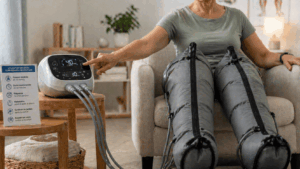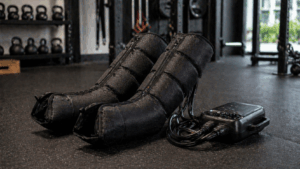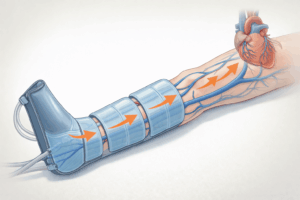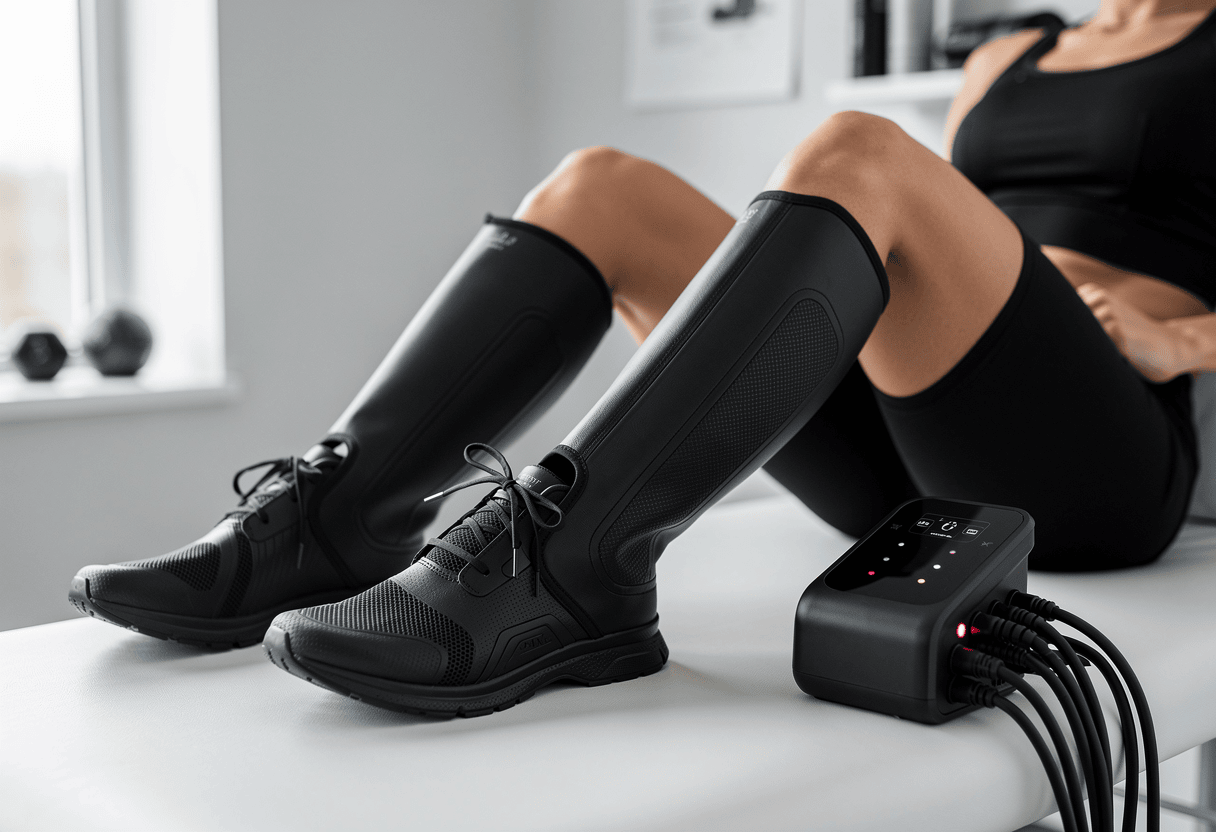
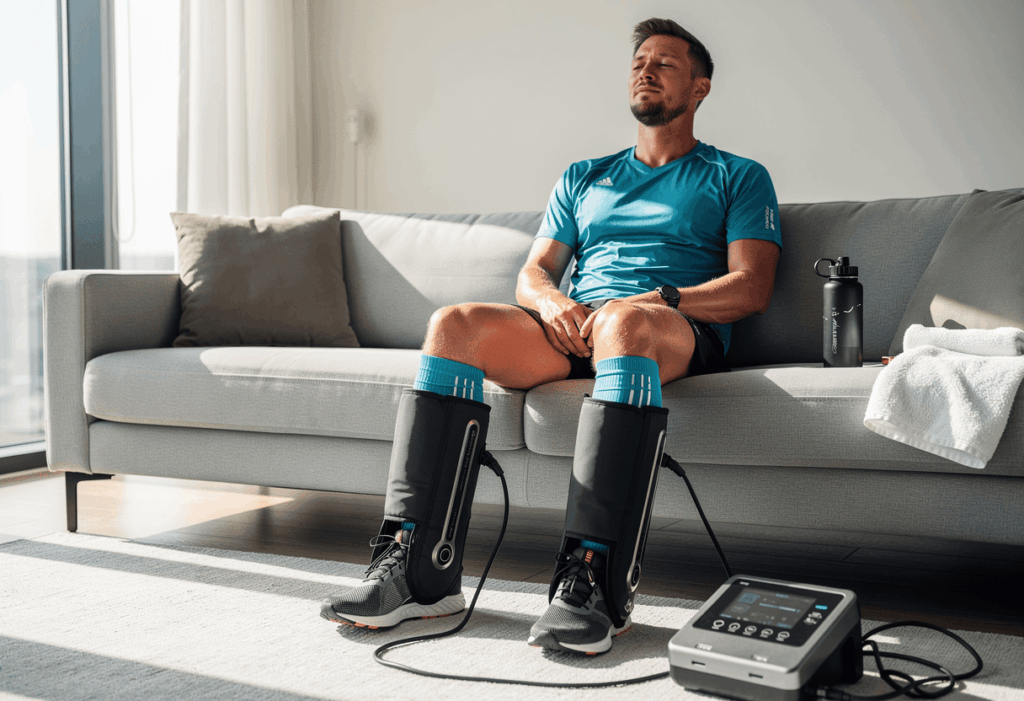
Running breaks down the legs in a very specific way. The repetitive eccentric loading hammers the calves, the long miles tax the quads beyond what casual lifters experience, and the recovery window between hard sessions is what determines whether you hit your next workout fresh or limp through it. Compression boots for running have become the most efficient at-home tool for closing that recovery window, and the brands that started in clinics now build models specifically tuned for endurance athletes.
We tested the leading recovery boots for marathon training across an 8-week block that included three 18+ mile long runs, weekly speed sessions, and a tune-up half marathon. Our scoring focuses on what actually matters for runners: how well the boots flush the calves and feet (where the worst soreness lives), how the pressure feels on tired quads after a long run, and whether the design fits into a serious training routine without becoming a chore.
The short answer: the Hyperice Normatec 3 remains the gold standard for serious runners. Its 5-zone pulse technology, 7 compression levels, and ZoneBoost targeting handle marathon-volume recovery better than anything else we tested, and it’s the boot used by elite endurance athletes for a reason.
How We Evaluate Compression Boots for Runners
Runner-specific scoring weighs calf and foot recovery more heavily than a general comparison would. Runners carry most of their day-to-day soreness in the lower leg, and the boot that flushes the calves cleanly is the boot you’ll actually use after every long run. Compression quality and pressure delivery still lead the criteria, but portability matters more than usual because runners travel for races, and battery life determines whether the boots come on race weekends or stay home.
| Compression quality | 30% | Pressure range, sequencing, calf and foot flush effectiveness |
| Adjustability | 25% | Pressure levels, zone targeting for problem areas |
| Portability | 15% | Travel-friendly for race weekends and training camps |
| Ease of use | 15% | Setup time after a long run when you’re exhausted |
| Value | 15% | Cost weighed against training volume and recovery need |
1. Hyperice Normatec 3: 7 levels, 5 zones, ZoneBoost, the runner’s gold standard
The Normatec 3 is the boot most professional marathoners and ultrarunners use, and after spending an entire training block with it we understand why. It runs Hyperice’s patented Pulse technology across 5 overlapping zones with 7 compression levels, and the sequential wave from foot to thigh is the smoothest we’ve felt in any compression system. After an 18-mile long run, a 30-minute session at level 5 left our calves and quads measurably less sore the next morning.
The feature that matters most for runners is ZoneBoost. You can lock extra pressure cycles onto a specific segment, which means you can target the calves alone after a track workout or the quads alone after a hilly long run. No other boot in this comparison gives you that level of region-specific control, and it pays off when you’re managing two or three problem areas simultaneously across a marathon block.
The trade-offs are real: it’s a tethered system with a hose-and-pump unit, the price is steep at around $799, and there’s no carry case included. The control unit takes up a small section of your living room. But for runners logging 40+ miles per week who need a recovery tool that actually keeps up with the workload, nothing else delivers the same consistent results.
2. Therabody JetBoots Prime: 4 chambers, fully wireless, fits in a backpack for race weekends
The JetBoots Prime is the boot for runners who travel. Therabody built a fully wireless system that folds flat and ships with a drawstring backpack, which means you can pack it for a race weekend and use it in a hotel room the night before your A-race or 30 minutes after crossing the finish line. For runners chasing PRs in destination marathons, that capability is worth the trade-offs.
The compression itself runs through 4 overlapping chambers with Therabody’s TruGrade Technology, delivering 4 pressure levels from 25 to 100 mmHg. The sequencing is clean, the calf and foot flush is solid, and the recovery effect after our long runs was comparable to the Normatec 3 – though without ZoneBoost, you can’t dial in extra pressure on a specific problem area.
Battery life is 3 hours, which gets you 6 full sessions per charge. The control panel lives on the right boot, which makes the right side feel slightly heavier and creates a small hard spot near the hip. After 8 weeks of testing we stopped noticing it. The bigger consideration: at 4 pressure levels instead of 7, you have less granularity for fine-tuning your session intensity. For runners who travel more than they train at home, the JetBoots Prime is the smarter pick.
3. Hyperice Normatec Go: calf-only, 7 levels, wireless, the runner’s targeted tool
The Normatec Go is the most runner-specific product in this lineup. Instead of a full-leg system, it’s a pair of calf-only wearable wraps with 7 compression levels, three overlapping 360-degree zones, and Bluetooth control via the Hyperice app. The premise is simple: the calf is the runner’s most-taxed muscle, and a focused tool that flushes the calves perfectly is more useful for many runners than a full-leg system that does everything moderately well.
What makes the Normatec Go work for runners specifically: you can wear it while standing, sitting at a desk, or even walking around the house. The integrated control unit means there’s no separate pump, so you can use it during cool-downs at the track, between sets at the gym, or on a long-haul flight to a race. It weighs just 1 lb 3 oz per wrap and is TSA-approved for carry-on.
The obvious limitation is that it doesn’t address the quads or hamstrings, which matters after hilly long runs or speedwork. If your soreness is consistently below the knee, the Normatec Go is the smarter $399 spend than a budget full-leg system. If your quads need work too, look at the full-leg options.
4. FIT KING FT-091A: 4 chambers, 12 levels, the budget pick for high-mileage amateurs
The FIT KING FT-091A is the boot for the recreational marathoner who wants real recovery but isn’t ready to drop $700+ on it. It runs 4 overlapping chambers covering foot, lower calf, upper calf, and thigh with 12 pressure levels from 40 to 150 mmHg, plus a cordless 3-to-4 hour battery. For roughly $200, you get the same fundamental sequential compression that drives the premium tier.
What it gives up is polish. The pump noise is louder, the controller is utilitarian, and there’s no app. But the recovery effect on a runner’s legs is genuinely close to a Normatec 3, and the 24-month warranty is the longest in this comparison. For amateurs running 30-50 miles per week who want consistent at-home recovery, this is the right starting point.
| # | Model | Score | Coverage | Price |
|---|---|---|---|---|
| 1 | Hyperice Normatec 3 | 9.5 | Full leg, 5 zones | ~$799 |
| 2 | Therabody JetBoots Prime | 9.0 | Full leg, 4 chambers | ~$699 |
| 3 | Hyperice Normatec Go | 8.6 | Calf only, 3 zones | ~$399 |
| 4 | FIT KING FT-091A | 8.0 | Full leg, 4 chambers | ~$200 |
What to Look for in Compression Boots for Running
Calf and foot flush as the priority
Runners accumulate fatigue from the ground up, and the boot that handles the lower leg cleanly is the one that actually delivers post-run results. Look for designs with at least 3 chambers below the knee and a true sequential pulse that starts at the foot. A boot that fires the thigh and calf simultaneously is doing massage, not lymphatic flush.
Pressure ceiling vs comfort tolerance
Most published recovery research uses pressures in the 60-100 mmHg range, which is exactly where the premium tier operates. Higher numbers sound better in marketing but rarely translate to faster recovery for runners. What matters more is that you can sustain a comfortable level for the full 20-30 minute session without your feet going numb.
Travel friendliness for race weekends
If you race more than twice a year in destination locations, factor portability into your purchase. A fully wireless system that folds flat and weighs under 7 lbs total will actually come with you. A tethered premium boot with a separate pump unit will stay home, which means you’ll skip recovery exactly when you need it most.
Single-leg vs both legs simultaneously
Some runners deal with chronic asymmetry – one calf or one IT band that’s always tighter than the other. Boots with a single-leg mode let you give the problem side an extra session without doubling your time investment. The FIT KING and Normatec Go both support this; the JetBoots Prime and Normatec 3 default to symmetrical operation.
Best Compression Boots for Runners – Frequently Asked Questions
How long should runners use compression boots after a long run?
The sweet spot for most runners is a 20-30 minute session within an hour or two of finishing the run. For very long efforts (18+ miles or marathon distance), a longer 45-60 minute session at moderate pressure delivers better results than a shorter session at maximum pressure. Don’t run sessions back-to-back on the same day – once is enough to flush a hard workout.
Should I use compression boots before a race or just after?
Both work, for different reasons. Before a race, a 15-20 minute light session at low pressure increases circulation and primes the legs without fatiguing them – many elite runners use this in the warmup window. After a race, a 30-45 minute session helps flush the metabolic byproducts of the effort and reduces next-day soreness. Skip them on rest days where you’re already feeling fresh.
Do compression boots actually reduce DOMS for runners?
The peer-reviewed research on intermittent pneumatic compression supports a moderate reduction in delayed-onset muscle soreness when used post-exercise, though the magnitude varies by individual. Studies show clearer effects on subjective soreness ratings than on objective performance markers like sprint times. For runners, that subjective improvement matters: feeling fresher the next morning means you’re more likely to hit your prescribed workout instead of dragging through an easier substitute.
Are compression boots worth it for amateur runners?
It depends on your weekly mileage. If you run 30+ miles per week and recovery between sessions is consistently limiting your training quality, the math works out – even a $200 budget pair pays for itself versus monthly sports massage costs within 3-4 sessions. If you run 15-20 miles per week as general fitness, the marginal benefit is smaller and your money is probably better spent on better shoes or coaching.
Calf-only or full-leg boots for runners?
This depends on where your soreness lives. Runners who carry most fatigue in the lower leg – common with forefoot strikers, hill runners, and shorter-distance specialists – get excellent value from a calf-only system like the Normatec Go. Marathoners and ultrarunners typically need the full-leg coverage because the quads take a real beating over 18+ miles. If you can only afford one pair and you’re not sure, the full-leg system is the safer bet.
Can I use compression boots every day during marathon training?
Yes, daily use is safe and recommended during peak training weeks. Most manufacturers and the published research support sessions up to 60 minutes per day at moderate pressure. The only caution is to vary the pressure rather than always running at maximum – your tissues adapt to the stimulus, and constant high pressure offers diminishing returns. Most runners do best alternating between a firmer session after hard workouts and a lighter flush on easier days.
In Summary
Runners get more out of compression boots than almost any other athlete because the demands of training are so consistent and the recovery window so tight. The Normatec 3 remains the gold standard for serious mileage, the JetBoots Prime is the right call if you race destination marathons, the Normatec Go is the smartest targeted spend for calf-dominant runners, and the FIT KING FT-091A is the budget on-ramp for amateurs who just want consistent recovery without the premium price.