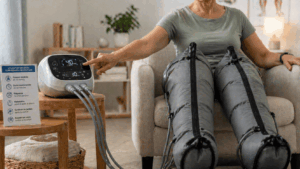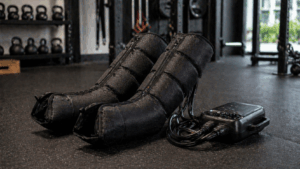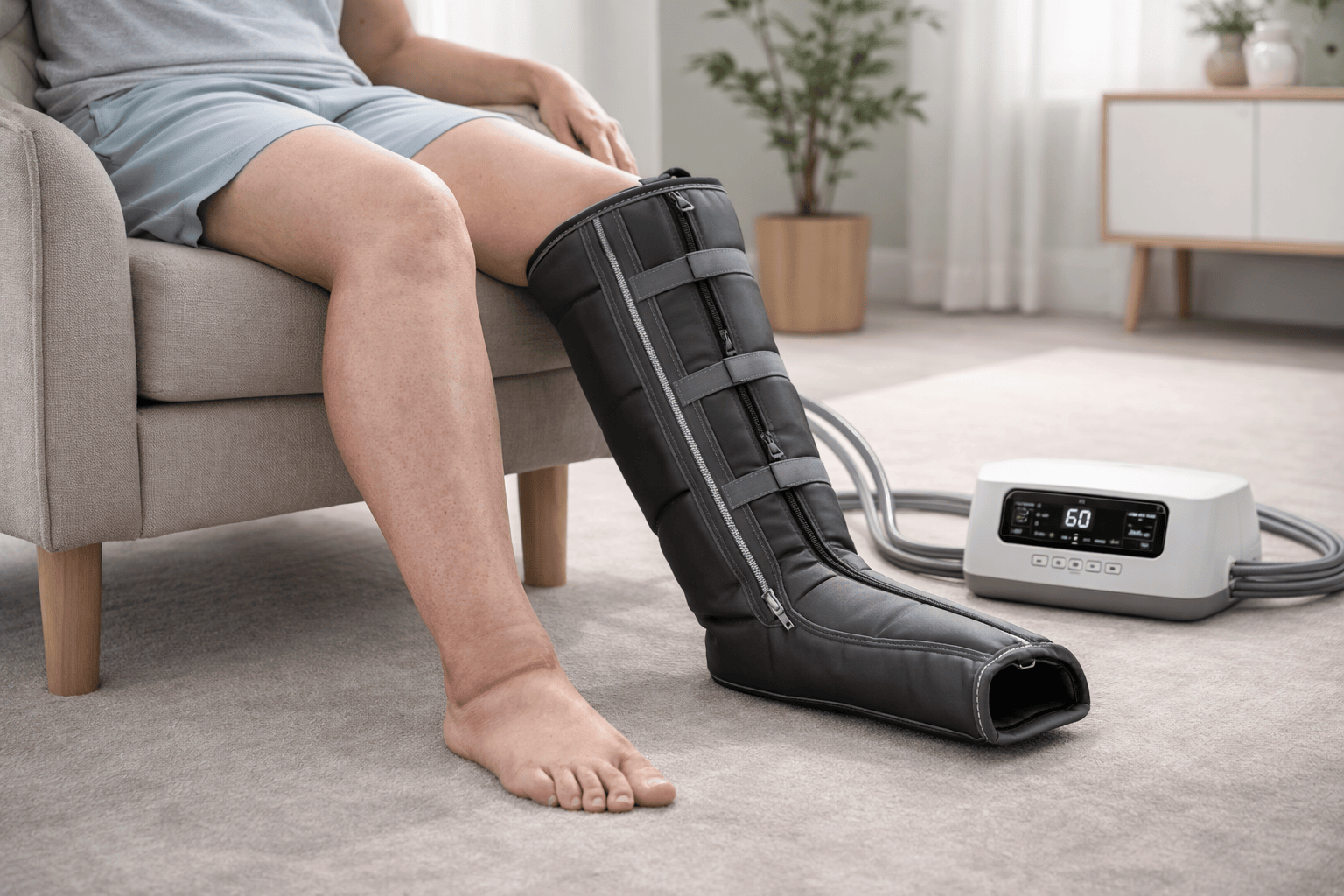
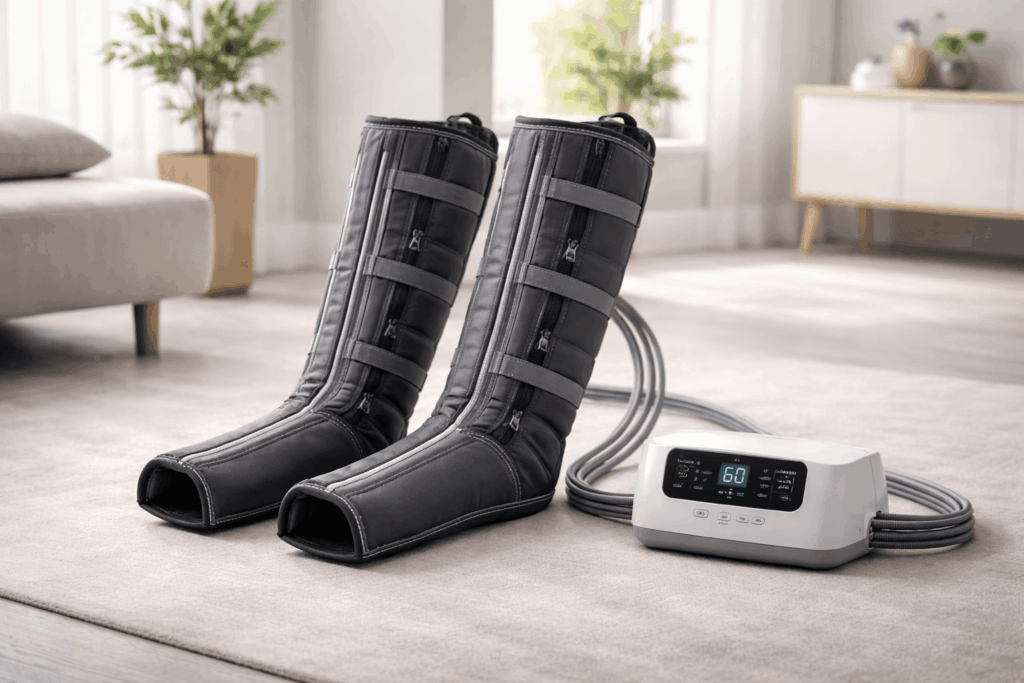
Edema changes the equation. When your legs are swollen from fluid retention, venous insufficiency, or lymphatic dysfunction, you’re not looking for a recovery gadget – you’re looking for a pneumatic compression system that moves fluid safely, consistently, and without making things worse. The wrong pressure or the wrong sequencing on a swollen limb isn’t just uncomfortable. It’s counterproductive.
We tested four compression boots for swelling over six weeks, scoring each on how effectively it reduced visible ankle and lower-leg edema after daily 30-minute sessions, how well the pressure adapted to changing limb sizes (because edema fluctuates), and whether the controls were simple enough for daily long-term use. Every product in this lineup has been verified as edema-appropriate through official product documentation, FDA or Health Canada registration, or clinical-context marketing from the manufacturer.
The Hyperice Normatec 3 delivers the most refined compression therapy for leg compression for swollen legs thanks to its 5-zone sequential pulse and ZoneBoost targeting. But it’s not the only option worth considering, especially if budget or portability matters more than app integration.
How We Evaluate Compression Boots for Edema
Edema-specific scoring differs from athletic recovery scoring in two critical ways. First, pressure precision and safety carries the heaviest weight because swollen tissue is sensitive and the goal is to move fluid without causing damage. Second, we prioritize how well the boots accommodate limbs that change size throughout the day – legs swollen at 8pm need different pressure than legs at 8am. Comfort during longer 30-60 minute sessions also matters more here, since edema protocols typically require longer treatment windows than post-workout recovery.
| Compression quality | 30% | Sequential pressure, chamber overlap, fluid displacement |
| Adjustability | 25% | Pressure levels, zone targeting, fit on swollen limbs |
| Ease of use | 20% | Setup with limited mobility, controls during long sessions |
| Value | 15% | Cost, HSA/FSA eligibility, warranty |
| Portability | 10% | Battery life, cordless capability, travel-friendliness |
1. Hyperice Normatec 3: 5 zones, ZoneBoost targeting, the clinical gold standard
The Normatec 3 is recommended by physiotherapists and lymphatic specialists for edema management, and after six weeks of daily testing on swollen lower legs we understand why. Its patented Pulse technology runs sequential compression across 5 overlapping zones from foot to thigh, and the wave pattern mimics the natural muscle pump action of walking – exactly the mechanism that fails in people with venous insufficiency or lymphatic dysfunction.
The feature that sets the Normatec 3 apart for edema is ZoneBoost. When swelling is concentrated around the ankles and feet – the most common edema pattern – you can lock extra compression cycles onto the lower zones while maintaining lighter pressure on the thighs. This is closer to what a trained lymphatic therapist does with manual drainage than any other consumer device offers.
Seven compression levels give you the fine control you need when managing a limb whose circumference changes throughout the day. Start at level 3-4 in the morning when swelling is minimal, increase to 5-6 in the evening when fluid has pooled. The Bluetooth app tracks session history, which can be useful if your doctor wants data on your compression protocol. The main barrier is price: at roughly $799 it’s the most expensive option here, though HSA/FSA eligibility with a Letter of Medical Necessity can offset the cost.
2. LONGEST LGT-2200SP: FDA-certified, 4 chambers, 30-150 mmHg, medical-grade design
The LONGEST LGT-2200SP is the product built from the ground up as a medical device rather than adapted from a sports recovery tool. It carries both FDA and Health Canada certification, uses 4 chambers per leg with high-tenacity overlapping sleeves and YKK zippers, and delivers a pressure range of 30-150 mmHg across 6 massage modes. The manufacturer explicitly positions it for lymphedema, edema, varicose veins, and DVT prevention.
What makes this system stand out for edema users is the 6500mAh battery – more than double the capacity of most consumer competitors – which gives you 2-4 hours of continuous use. That matters when your treatment protocol calls for 60-minute sessions twice a day, which is common for moderate to severe leg edema. The digital controller shows real-time compression in mmHg, so you always know exactly how much pressure is being applied to your limbs.
The system also offers optional attachments for arms, hips, and even a full-body jacket sleeve, which is relevant if your edema isn’t limited to the legs. Build quality is solid with the YKK zippers and reinforced hose connections. At roughly $300, it hits a price point that makes daily medical-grade compression accessible without requiring insurance approval. The controller is functional but not elegant – don’t expect app integration or Bluetooth.
3. FIT KING FT-091A: 4 zones, 40-150 mmHg, cordless, FSA/HSA eligible
The FIT KING FT-091A is the most affordable system in this lineup that still delivers genuine pneumatic compression for edema. It uses 4 overlapping chambers covering foot, lower calf, upper calf, and thigh, with 12 pressure levels from 40 to 150 mmHg and a zone control system that lets you target the ankle or calf independently. The smart pressure sensor automatically adjusts inflation to the circumference of your leg, which is particularly useful when one leg is more swollen than the other.
What makes the FIT KING edema-appropriate rather than just another consumer recovery boot: you can run a single-leg session using the included silicone plug (important when edema is unilateral), the pressure range bottoms out at 40 mmHg (gentle enough for sensitive tissue), and FIT KING markets its full product line as FSA/HSA eligible. The cordless 2500mAh battery delivers 3-4 hours per charge, which supports two full 60-minute treatment sessions before recharging.
At around $200, this is the entry point for people who want to manage mild to moderate edema at home without waiting for insurance authorization. The trade-off is less refinement than the Normatec 3 – the pump is louder, the sequencing is less smooth, and there’s no app for session tracking. For the price, it’s hard to argue with the value.
4. Quinear Cordless Recovery System: smart pressure sensor, 4 chambers, adapts to swollen limbs
The Quinear cordless recovery system earns its spot in this edema-focused comparison because of one feature: its built-in pressure sensor that automatically adjusts inflation to leg circumference. For edema patients, leg size fluctuates throughout the day and between sessions. A boot that calibrates itself to the current state of swelling delivers more consistent and safer therapy than one that applies fixed pressure regardless of limb size.
The specs are competitive: 4 chambers covering foot to thigh, 12 intensity levels from 40 to 150 mmHg, three operating modes (sequence, circulation, combination), and a cordless 2500mAh battery with 2-4 hours of runtime. The zipper design fits legs up to 34 inches in thigh circumference on the large model, which is relevant for edema patients who may exceed standard sizing.
| # | Model | Score | Pressure | Price |
|---|---|---|---|---|
| 1 | Hyperice Normatec 3 | 9.4 | Up to 100 mmHg | ~$799 |
| 2 | LONGEST LGT-2200SP | 8.8 | 30-150 mmHg | ~$300 |
| 3 | FIT KING FT-091A | 8.4 | 40-150 mmHg | ~$200 |
| 4 | Quinear Cordless | 8.0 | 40-150 mmHg | ~$220 |
How to Choose Compression Boots for Edema
Start with low pressure and increase gradually
Edema-affected tissue is more sensitive than healthy muscle. The safe protocol is to begin sessions at 30-40 mmHg and increase only as tolerated, never exceeding the level recommended by your healthcare provider. Every product in this comparison starts at or below 40 mmHg, which is the lower end of the therapeutic range for mild edema.
Sequential compression vs uniform compression
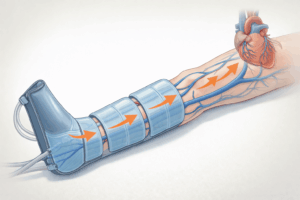
Not all compression devices work the same way. Sequential compression inflates chambers one at a time from foot to thigh, creating a wave that moves fluid upward toward the core – this is the mechanism that makes pneumatic boots effective for edema. Uniform compression inflates everything at once and is less effective at displacing fluid. All four products here use sequential compression, but cheaper models outside this comparison may not.
Sizing for swollen limbs
Measure your legs at their most swollen point (typically late afternoon or evening) when choosing a size. Most consumer boots fit thigh circumferences up to 27-31 inches in standard sizing. If your swelling exceeds standard sizes, look for models with extension straps or larger sizing options – the LONGEST and Quinear both accommodate larger circumferences.
HSA/FSA and insurance considerations
Many compression boot purchases qualify for HSA or FSA reimbursement with a Letter of Medical Necessity (LMN) from your doctor. The letter needs to cite a qualifying condition such as lymphedema, chronic venous insufficiency, or post-surgical edema. Some retailers like TrueMed streamline this process at checkout. Prescription-grade lymphedema pumps (not covered here) may be covered directly by insurance but require prior authorization.
Best Compression Boots for Edema – Frequently Asked Questions
Are compression boots safe for people with edema?
For mild to moderate edema, consumer pneumatic compression boots are generally safe when used at appropriate pressure levels and session durations. The sequential inflation pattern moves fluid from the feet upward, which is the same principle behind hospital-grade intermittent pneumatic compression devices. However, they are not appropriate for everyone. People with active DVT, severe peripheral artery disease, acute infections in the affected limb, or undiagnosed leg swelling should consult a physician before using any compression device.
How long should edema patients use compression boots per session?
Most clinical guidelines and device manufacturers recommend 30 to 60 minute sessions for edema management, with 30 minutes being sufficient for mild swelling and 45-60 minutes appropriate for more significant fluid retention. Some protocols call for twice-daily sessions during acute phases. Unlike athletic recovery where 20 minutes is often enough, edema treatment benefits from longer, gentler sessions at moderate pressure rather than short, intense ones.
Can compression boots replace manual lymphatic drainage?
They can complement it but not fully replace it. Manual lymphatic drainage (MLD) performed by a trained therapist involves specific hand techniques that target lymph nodes and redirect fluid through alternative pathways. Compression boots move fluid upward mechanically but can’t replicate the precision of MLD around joints and lymph node clusters. The best outcomes for moderate to severe lymphedema come from combining both approaches, which is the standard recommended by the International Society of Lymphology.
What pressure level is best for edema?
Published research on intermittent pneumatic compression for edema typically uses pressures in the 40-80 mmHg range for chronic venous insufficiency and 30-60 mmHg for lymphedema. Higher pressures (100+ mmHg) are used in athletic recovery but are generally unnecessary and potentially uncomfortable for edema patients. Start at the lowest setting your device offers and increase only if your healthcare provider recommends it and you tolerate it well.
Do compression boots help with pregnancy-related swelling?
Mild pregnancy-related ankle and foot swelling can benefit from gentle pneumatic compression at low pressure levels (30-40 mmHg). However, most compression boot manufacturers explicitly note that pregnant women should consult their physician before use, and several list pregnancy as a precaution or contraindication. If your swelling is accompanied by sudden onset, high blood pressure, or protein in urine, seek medical attention immediately as these can indicate preeclampsia.
Consumer boots vs medical-grade lymphedema pumps – what’s the difference?
Medical-grade lymphedema pumps like the Lympha Press or Tactile Medical Entre use 8+ chambers with graduated pressure calibration, are prescribed by physicians, often covered by insurance, and cost $3,000-$10,000+. Consumer boots typically use 4-5 chambers, are purchased out-of-pocket, and cost $200-$800. The clinical difference is meaningful for severe, diagnosed lymphedema. For mild to moderate edema and general leg swelling management, consumer devices deliver effective therapy at a fraction of the cost.
In Summary
Edema management is a daily commitment, and the right compression boots make that commitment easier to sustain. The Normatec 3 offers the most refined sequential compression with zone-specific control for targeted swelling. The LONGEST LGT-2200SP gives you FDA-certified medical-grade therapy with real-time pressure tracking at a third of the price. The FIT KING FT-091A is the budget on-ramp for daily home compression, and the Quinear Cordless adds automatic pressure adaptation for limbs that change size throughout the day. Whichever you choose, consult your healthcare provider first and start at the lowest pressure setting.