This comparison gets framed as a battle on nearly every recovery blog, but compression boots and massage guns are not competing for the same job. They work through entirely different mechanisms, target different physiological systems, and solve different problems. Asking which is “better” is like asking whether a foam roller or a good night’s sleep is more important.
The more useful question is which one solves the specific recovery problem you actually have. For most athletes training seriously, the answer eventually becomes both, used at different times for different purposes. But if you are buying one first, the decision comes down to training volume, body region, and how you prefer to spend your recovery time.
Here is the honest breakdown, mechanism by mechanism, with the research behind each tool laid out without the marketing noise.
How Each Tool Works
The mechanisms are fundamentally different, which is why direct comparison studies between the two barely exist. They are not doing the same thing.
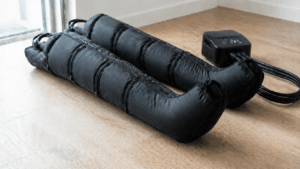
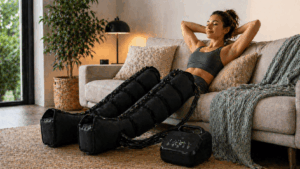
Compression boots use intermittent pneumatic compression (IPC). Air chambers inflate sequentially from foot to thigh, then deflate and repeat. The squeeze-release cycle pushes venous blood and lymphatic fluid upward toward the heart, mimicking the action of the calf muscle pump. The effect is systemic across the entire leg, passive (you sit and let the device work), and primarily targets the circulatory and lymphatic systems. Pressures range from 30 to 110 mmHg depending on the device and setting.
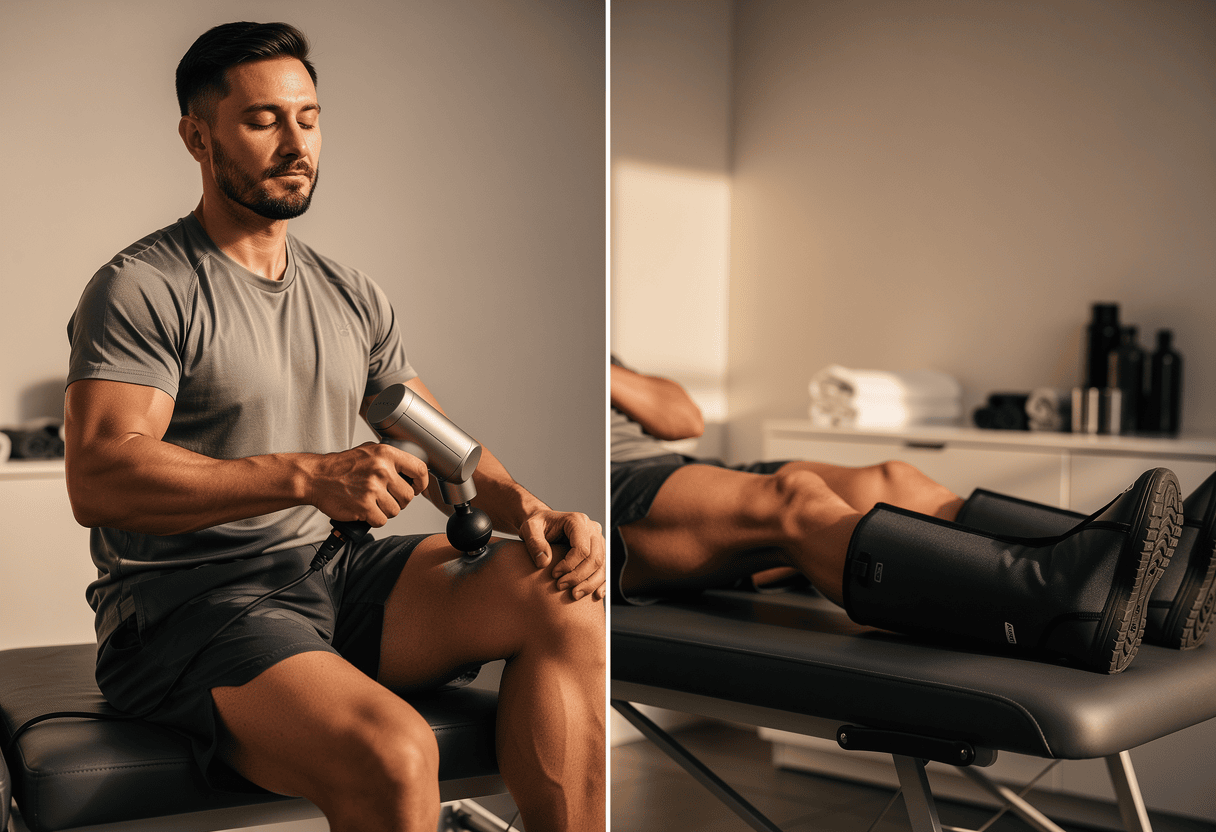
Massage guns use percussive therapy. A motor drives a tip into the muscle at 1,800 to 3,200 percussions per minute, delivering rapid bursts of mechanical pressure to a targeted area. The effect is localized to wherever you aim the gun, active (you control the angle, pressure, and duration), and primarily targets myofascial tissue, trigger points, and soft tissue stiffness. Amplitude ranges from 10 to 16 mm on quality devices.
In practical terms: the boots flush your whole leg while you watch something. The gun digs into a specific knot in your calf while you control exactly how much pressure to apply. Different mechanisms, different targets, different user experience.
What the Research Supports for Each
Neither tool has a massive body of high-quality evidence behind it, but both have enough published data to draw honest conclusions.
Compression boots: a 2022 meta-analysis in the Journal of Clinical Medicine found moderate effect sizes for pressotherapy reducing DOMS severity. A 2024 meta-analysis in Biology of Sport, covering 17 studies and 319 athletes, found small but consistent improvements in subjective recovery markers. The venous return effect is well documented across decades of vascular medicine research. The boots reliably make your legs feel fresher, even when objective performance markers show smaller changes.
Massage guns: the research is younger and thinner. A 2023 systematic review in the Journal of Functional Morphology and Kinesiology analyzed the available evidence on percussive therapy and found promising but limited data on range of motion improvement and pain reduction. A 2024 study from La Trobe University found that 5 minutes of massage gun application after strenuous lower-body exercise produced a slight increase in soreness immediately and at 4 hours post-exercise, suggesting short sessions may transiently sensitize tissue rather than help. A 2023 systematic review in the International Journal of Sports Physical Therapy found that percussive therapy showed potential for improving flexibility and reducing pain, but noted the evidence was drawn from small studies with methodological limitations.
The honest summary: compression boots have a larger and slightly more mature evidence base for whole-leg recovery. Massage guns have a smaller but growing evidence base for localized flexibility and trigger point relief. Neither has overwhelming proof of dramatic performance enhancement.
Soreness Reduction
Compression boots have the edge here. The meta-analyses consistently show moderate effects on perceived DOMS, and the mechanism makes physiological sense: reducing edema and improving venous return addresses one of the primary causes of post-exercise leg heaviness and soreness.
Massage guns can reduce localized soreness in a targeted muscle, but the La Trobe 2024 study raises an important nuance: short percussive sessions may temporarily increase sensitivity in tissue that is already inflamed from exercise. The “working into” a sore muscle approach can backfire if the tissue is acutely damaged.
For general leg soreness after a long run, heavy squat session, or cycling block, the boots are the more effective tool. For a specific sore spot, a tight IT band, or a particular calf knot that compression cannot reach with precision, the gun is more useful.
Range of Motion and Flexibility
Massage guns have the edge here. The systematic reviews on percussive therapy consistently find short-term improvements in range of motion, particularly when applied to muscles before stretching or exercise. The mechanism is myofascial release: the rapid percussive strokes reduce tissue stiffness and adhesions in a way that compression cannot replicate.
Compression boots may slightly mitigate flexibility loss after intense exercise by reducing swelling that restricts joint range. But the effect is indirect and smaller than what targeted percussive work produces.
For pre-workout mobility, tight hamstrings, restricted ankle dorsiflexion, or chronic tissue stiffness, the massage gun is the right tool. Compression boots do not address fascial restrictions or trigger points.
Circulation and Lymphatic Drainage
Compression boots win this category decisively. IPC was developed specifically to improve venous return and lymphatic drainage, and the Doppler ultrasound evidence is consistent and strong. The sequential inflation pattern moves fluid across the entire leg in a way that a handheld percussive device cannot replicate.
Massage guns increase local blood flow to the area being treated, which is useful for nutrient delivery to a specific muscle. But they cannot produce the whole-leg venous return effect that boots deliver. If you are dealing with leg swelling, post-flight puffiness, or general circulatory heaviness, the boots are the only tool that directly addresses the problem.
Convenience and Usability
This is where the massage gun has a major practical advantage that the recovery science does not capture.
A massage gun weighs 1 to 3 pounds, fits in a gym bag, charges via USB, and works on any body part in any location. You can use it on your upper back, shoulders, forearms, glutes, and feet, not just your legs. A 90-second session on a tight area before training takes almost no time or setup.
Compression boots require 20 to 30 minutes of sitting still, cover only the legs, weigh 5 to 15 pounds with the pump, and need a couch or flat surface. They are a living-room tool, not a portable one. Some models (like the Normatec Go) have improved portability for travel, but even those are limited to calf-only.
For athletes who travel constantly, train at different gyms, or need quick targeted work between sets, the massage gun’s portability is a significant advantage. For athletes who have a consistent home routine and want a hands-free recovery session, the boots fit better.
Cost Comparison
The price gap is significant and worth factoring into the decision.
Quality massage guns run $100 to $400. The Theragun Pro is around $400, the Theragun Mini is around $150, and there are competent mid-range options from Ekrin, Bob and Brad, and others in the $100 to $200 range. The entry point for a functional massage gun is low.
Quality compression boots run $200 to $1,000+. Budget options from Fit King start around $150 to $200. Mid-range options like the Normatec Go (calf-only) sit at $399. Full-leg premium systems like the Normatec 3 ($799) and the Normatec Elite ($999) sit at the top.
If you have $150 to spend on recovery, a massage gun gives you a functional, versatile tool that covers upper body, lower body, and pre-workout mobility. The compression boots only become cost-competitive at the budget tier, and at that price point you are trading build quality and features for the core compression mechanism.
If you have $400+ to spend and your primary recovery need is lower-body specific, the boots deliver more recovery value per session for leg-dominant athletes. At $800+, you are in premium territory for either tool, and the question becomes which one you will actually use more consistently.
Who Should Buy Compression Boots First
The boots are the right first purchase if your recovery profile matches any of these situations.
You train primarily with your legs. Runners, cyclists, triathletes, marathon walkers, soccer players, basketball players. Your recovery bottleneck is leg fatigue and soreness, and the boots address the entire leg simultaneously in a hands-free, passive session.
You train at high volume (4+ sessions per week). The systemic flushing effect and consistent perceived freshness add up meaningfully over weeks and months of heavy training. The boots earn their keep through daily consistency, not one-off sessions.
You stand or sit all day at work. The venous return benefit for nurses, teachers, desk workers, and frequent travelers is the boots’ strongest non-athletic use case, and the massage gun does not address it at all.
You already own a foam roller or basic massage stick. If you have some way to address localized trigger points, the boots add a recovery dimension you are currently missing entirely.
Who Should Buy a Massage Gun First
The gun is the right first purchase if your recovery profile matches any of these situations.
You train with your whole body, not just your legs. CrossFit, powerlifting, Olympic lifting, swimming, climbing, team sports with significant upper-body demands. The boots only cover your legs. The gun covers everything.
You have a tight budget. A $150 massage gun is a functional recovery tool that handles pre-workout mobility, post-workout targeted relief, and everyday tension management. A $150 pair of compression boots is a basic device with limited durability and features.
You travel frequently or train at different locations. The gun fits in a gym bag and works anywhere. The boots need a couch, a power outlet (unless wireless), and 25 minutes of your time.
You have specific chronic tension points. Tight hip flexors, locked-up upper traps, stubborn plantar fascia, chronic IT band issues. The gun delivers targeted myofascial work that compression cannot reach or replicate.
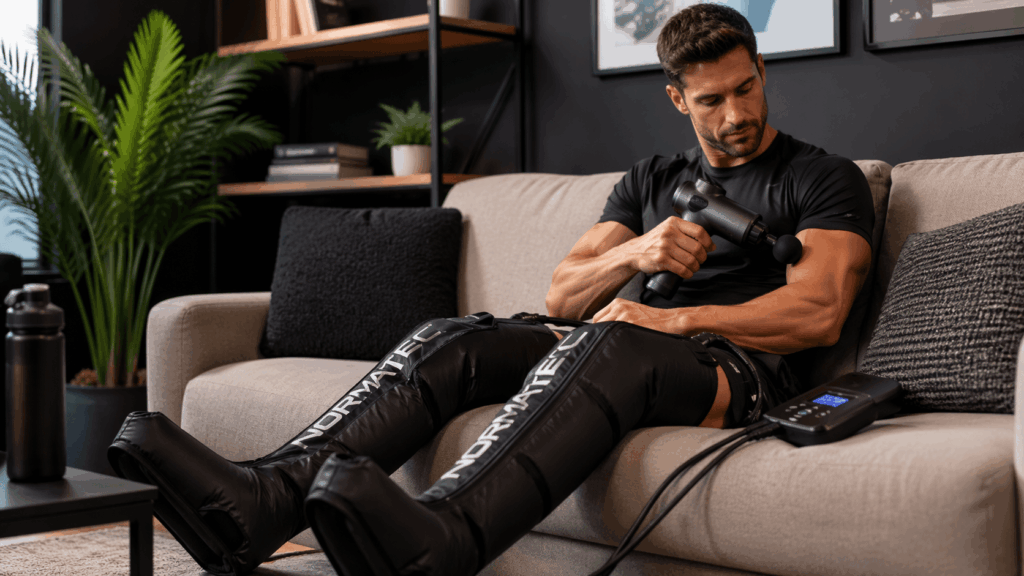
Using Both Together
For athletes with the budget and the discipline, the most effective approach is using both tools in sequence.
Pre-workout: 60 to 90 seconds of massage gun work on tight areas (hip flexors, calves, ankles) to improve range of motion and warm-up readiness.
Post-workout: 5 minutes of foam rolling or massage gun on specific sore spots, followed by 20 to 25 minutes in the compression boots for whole-leg flushing. This sequence addresses both the localized myofascial component and the systemic circulatory component of recovery.
The tools do not overlap. Running the massage gun on your quads while wearing the boots is not practical (the boots are in the way) and not necessary (you address different tissue layers at different times). Use them sequentially, not simultaneously.
Compression Boots vs Massage Gun, Frequently Asked Questions
Is a Normatec better than a Theragun?
They are not comparable products. The Normatec is a full-leg pneumatic compression system for systemic venous return and soreness reduction. The Theragun is a handheld percussive device for localized myofascial release and trigger point work. Asking which is “better” depends entirely on what you need. If your legs are your primary recovery concern, the Normatec delivers more value. If you need whole-body targeted relief, the Theragun is more versatile.
Can a massage gun replace compression boots?
No. A massage gun cannot replicate the systemic venous return, lymphatic drainage, and whole-leg flushing effect that pneumatic compression produces. It addresses a completely different layer of recovery. You could spend 30 minutes running a massage gun up and down both legs and still not achieve the circulatory effect that 20 minutes in the boots delivers passively.
Can compression boots replace a massage gun?
No. Compression boots cannot target a specific knot in your upper trap, release a locked-up IT band, or improve ankle mobility through myofascial work. They do not address fascial adhesions or trigger points. The two tools complement each other because they target different physiological systems.
Which one is better for runners?
For runners training at serious volume (40+ miles per week), compression boots are usually the higher-value first purchase. The primary recovery bottleneck for high-volume runners is leg fatigue, swelling, and perceived heaviness, all of which the boots directly address. A massage gun is a useful supplement for calf tightness, plantar fascia, and hip flexor work, but it does not address the systemic leg recovery that runners need most.
Which one is better for CrossFit?
The massage gun is usually the better first purchase for CrossFit athletes, because CrossFit training loads are distributed across the entire body, and the gun covers upper back, shoulders, forearms, and hips in addition to legs. If you later find that leg recovery specifically is your bottleneck, add boots.
Can I use both on the same day?
Yes, and many serious athletes do. Use the massage gun first for targeted work (2 to 5 minutes per area), then sit in the boots for 20 to 25 minutes. The sequence addresses localized myofascial tissue first, then systemic circulation. There is no interference between the two modalities.
Which has better evidence behind it?
Compression boots have a slightly larger and more mature evidence base, built on decades of IPC research in vascular medicine plus newer athletic recovery studies. Massage guns have a growing but younger evidence base with promising results for flexibility and pain reduction but smaller sample sizes and fewer meta-analyses. Neither tool has overwhelming proof of dramatic performance enhancement.
The Bottom Line
Compression boots and massage guns are not competing tools. They target different physiological systems through different mechanisms, and the “which is better” framing misses the point entirely.
Buy compression boots first if your primary recovery need is lower-body fatigue, you train at high volume with your legs, or you stand/sit all day. Buy a massage gun first if your recovery needs are full-body, you have a tight budget, you need portability, or you have specific chronic tension points the boots cannot reach.
If you can afford both, use both. The massage gun handles targeted myofascial prep and relief, the boots handle systemic leg recovery, and together they cover more recovery ground than either tool alone. The best recovery stack is not about choosing one, it is about knowing which tool to reach for and when.