Compression boots and compression socks both squeeze your legs to improve blood flow. That single similarity is where the comparison starts and ends, because they work through entirely different mechanisms, serve different purposes, and fit into different parts of your day.
The confusion is understandable. Both products use the word “compression” and both claim to help with recovery, circulation, and soreness. But asking whether compression boots are better than socks is like asking whether a warm-up jog is better than a post-workout stretch. They do different things at different times, and most serious athletes benefit from owning both.
Here is the honest comparison, with the research behind each tool separated from the marketing claims.
The Core Mechanical Difference
Understanding this one distinction explains almost everything else in the comparison.
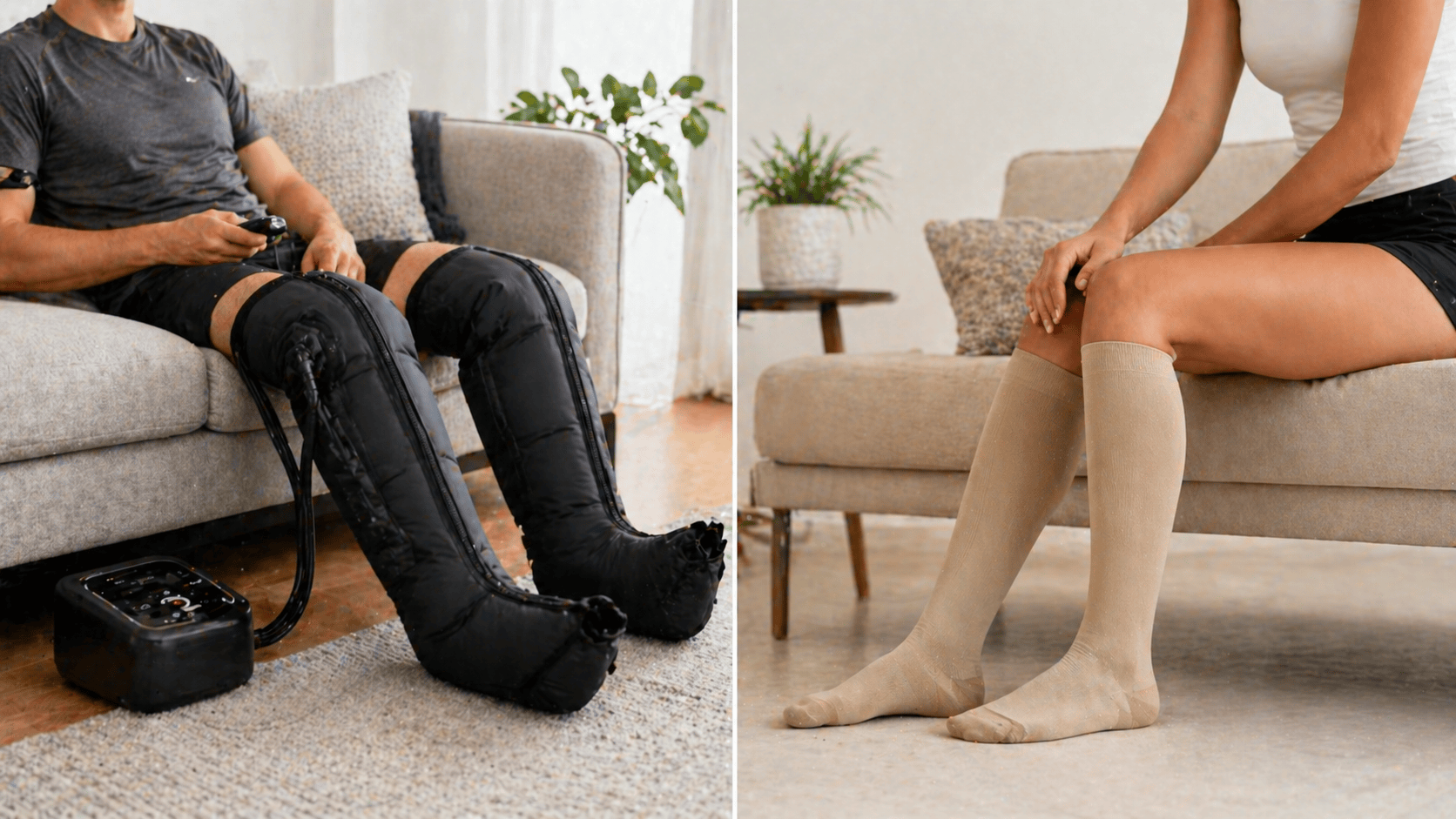
Compression socks apply static, constant, graduated pressure. A medical-grade pair typically delivers 20 to 30 mmHg at the ankle, tapering to lower pressure at the calf. The pressure is always on, always the same, and works passively by reducing vein diameter so blood naturally flows faster through the narrowed vessel. You wear them during activity, during travel, during a work shift, or after exercise.
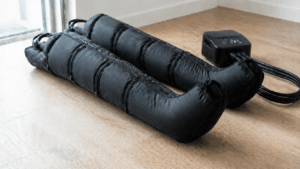
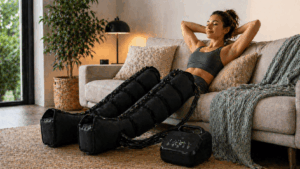
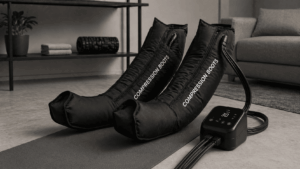
Compression boots apply dynamic, intermittent, sequential pressure. Air chambers inflate from foot to thigh in a wave-like pattern at 30 to 110 mmHg, then deflate completely and start again. The pressure pulses on and off, and the sequential pattern actively pumps blood and lymphatic fluid upward. You use them for 20 to 30 minute sessions while sitting or lying down.
The analogy that clarifies everything: compression socks are like keeping the garden hose on a slow trickle all day. Compression boots are like turning on a powerful sprinkler for 25 minutes. Both water the garden, but through completely different delivery methods and at completely different rates.
What the Research Says About Each
Both tools have substantial published evidence behind them, but the evidence covers different outcomes.
Compression socks: a 2013 meta-analysis published in the British Journal of Sports Medicine, pooling data from 12 studies, found that compression garments produced a moderate effect on reducing DOMS severity (Hedges’ g = 0.403), muscle strength recovery, muscle power recovery, and creatine kinase levels. A 2025 systematic review in Life found that compression garments worn during or within 24 hours after exercise significantly mitigated the decline in muscle strength. The evidence for wearing socks during exercise is more mixed, with modest reductions in perceived exertion and muscle oscillation, but inconsistent performance benefits.
Compression boots: a 2022 meta-analysis in the Journal of Clinical Medicine found moderate effect sizes for IPC reducing DOMS severity. A 2024 meta-analysis in Biology of Sport, covering 17 studies and 319 athletes, found small but consistent improvements in subjective recovery markers. Notably, a 2025 comprehensive review in Physical Therapy in Sport analyzed six studies comparing IPC boots directly to other recovery methods (including compression garments) and found no clear evidence that boots are superior or inferior to alternatives, though the study count was small.
The honest takeaway: both tools reduce perceived soreness at roughly comparable effect sizes. The boots may produce slightly larger acute effects during the session, while the socks produce smaller but more sustained effects when worn for extended periods. Neither tool has proven dramatically superior to the other for DOMS reduction.
When to Use Compression Socks
Socks excel in situations where you need sustained, low-level compression over long periods. That makes them the right tool for several specific contexts.
During a run, race, or training session. The socks reduce calf muscle oscillation (the bouncing of muscle tissue during impact), which may reduce micro-damage accumulation during long efforts. They also provide mild circulatory support while you are moving. You cannot wear compression boots while running.
During a long flight, drive, or extended sitting. The constant pressure prevents venous pooling from developing in the first place, rather than clearing it after the fact. For anyone traveling more than four hours in a seated position, graduated compression socks are the most practical tool available.
During an 8+ hour work shift on your feet. Nurses, teachers, retail workers, and hospitality staff benefit from the sustained vascular support that socks provide throughout the day. Wearing them all shift prevents the heavy, swollen legs that develop by evening.
Overnight after hard training. Some research suggests that wearing compression socks for 12 to 24 hours post-exercise, including during sleep, enhances their DOMS-reducing effect. The sustained gentle pressure keeps venous return elevated across the entire recovery window.
Daily if you have mild venous insufficiency or varicose veins. Graduated compression stockings are the first-line conservative treatment for chronic venous insufficiency, and the clinical evidence for daily wear in these populations is strong and well-established.
When to Use Compression Boots
Boots excel in situations where you need a powerful, focused recovery stimulus in a short window. They deliver more pressure and more active fluid movement than socks can provide.
Within an hour of finishing a hard workout. The sequential pump clears exercise-induced edema and metabolic byproducts more aggressively than static compression. If your legs are already heavy and swollen, the boots provide a stronger acute response than pulling on a pair of socks.
Post-race recovery at an event. Many marathon and triathlon recovery zones now provide compression boots for exactly this reason. Twenty minutes in the boots after a race addresses the acute swelling and fluid accumulation more powerfully than any static garment.
Evening recovery during a heavy training block. If you are stacking hard sessions multiple days in a row, a 25 minute boot session in the evening prepares your legs for the next day more actively than wearing socks to bed. The difference is small, but cumulative over a four-week block.
Managing post-exercise leg heaviness when you have been sitting all day. If you forgot your compression socks at home and sat at a desk for nine hours before training, the boots can clear the accumulated pooling that developed during the workday in a way socks cannot do retroactively.
Where Each Tool Falls Short
Every recovery tool has limitations, and knowing them prevents wasted money and unrealistic expectations.
Compression socks cannot produce the sequential pump effect. They provide constant pressure, which improves flow rate through the veins, but they do not actively push fluid upward the way the boots’ inflate-deflate cycle does. For acute post-exercise flushing, the boots are more powerful.
Compression socks lose effectiveness when sized or positioned poorly. A sock that slides down or bunches at the ankle creates pressure gaps that undermine the graduated effect. Medical-grade socks must be fitted properly to deliver the correct pressure gradient.
Compression boots only cover your legs. If you need upper body, hip, or foot compression during activity, the boots are irrelevant. Socks, sleeves, and garments cover a broader range of body regions.
Compression boots require 20 to 30 minutes of being stationary. You cannot use them at work, while traveling (unless you are a passenger with room to stretch out), or during training. The socks work passively in any situation.
Compression boots cannot be worn during exercise. This is the most fundamental limitation. The socks provide support while you train. The boots are a post-training tool only.
Cost Comparison
The price gap between these two tools is enormous, and it shapes the value equation significantly.
A quality pair of graduated compression socks costs $20 to $60. Medical-grade options from CEP, Sockwell, Vim & Vigr, and similar brands sit in this range. You may need two or three pairs to rotate through a training week, so the real cost is $60 to $150 for a full rotation. They last 6 to 12 months of regular use before the compression degrades.
Compression boots cost $150 to $1,000+. Budget options from Fit King start around $150. Mid-range options sit at $300 to $500. Premium devices like the Normatec 3 ($799) and Normatec Elite ($999) top out the consumer range. They typically last 5 to 10 years with normal use.
On a per-use basis over a year, the socks are dramatically cheaper. But the comparison is not quite apples to apples, because the socks and boots serve different functions. The socks are a daily wearable. The boots are a recovery session device. You would not replace one with the other any more than you would replace sunscreen with after-sun lotion.
Using Both Together
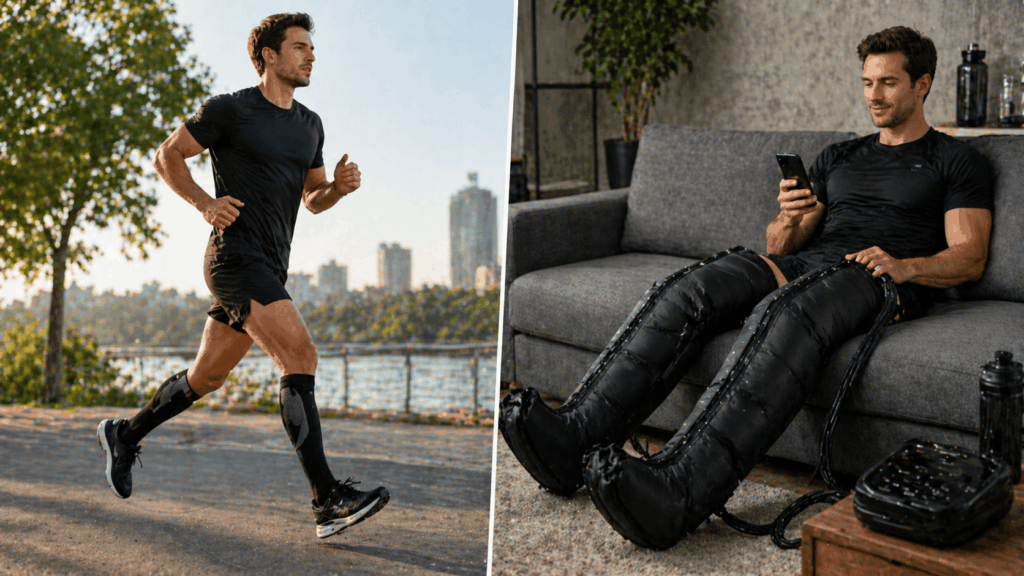
For athletes training at serious volume, the strongest recovery protocol uses both tools at different points in the day.
During the run or workout: compression socks provide mild circulatory support and reduce muscle oscillation throughout the effort.
Within an hour post-workout: 20 to 25 minutes in the compression boots for aggressive fluid clearance and acute recovery stimulus.
After the boot session through bedtime: back into compression socks (a fresh pair) for sustained gentle pressure that extends the recovery window overnight.
This is the protocol used by many professional teams and college programs, and it makes physiological sense because you are covering the full timeline: prevention during activity, aggressive treatment post-activity, and sustained maintenance through sleep. Whether the marginal benefit over using just one tool justifies the cost depends entirely on your training volume and recovery demands.
Which Should You Buy First
If you can only afford one, the answer depends on your training pattern and lifestyle.
Buy compression socks first if: you train three or fewer times per week, you travel frequently, you stand or sit all day for work, you want the simplest and cheapest recovery tool available, or you need something you can wear during runs and races. The socks cover more situations for less money.
Buy compression boots first if: you train four or more times per week with serious lower-body volume, your primary recovery problem is acute post-workout leg heaviness and soreness, you already own compression socks and want to add a recovery dimension you are missing, or you would otherwise be paying for sports massage.
For most recreational athletes, compression socks are the smarter first purchase. They are cheaper, more versatile, usable during activity, and cover the basic circulatory support that most people need. Compression boots become worthwhile when your training volume pushes past the point where socks alone cannot manage the recovery load.
Compression Boots vs Compression Socks, Frequently Asked Questions
Are compression boots better than compression socks for recovery?
Better is not the right frame. Boots deliver a more powerful acute recovery stimulus in a 25 minute session. Socks deliver a milder but sustained stimulus over many hours. For acute post-workout flushing, the boots are stronger. For sustained daily circulatory support, the socks are more practical. A 2025 review comparing IPC boots to other recovery methods, including compression garments, found no clear superiority for either approach.
Can I wear compression socks instead of using compression boots?
For most recreational athletes, yes. Compression socks provide meaningful circulatory support and moderate DOMS reduction at a fraction of the cost. You would miss the aggressive sequential pump effect the boots provide, but for training volumes under four sessions per week, the socks cover the majority of your recovery needs.
Can I wear compression socks inside compression boots?
You can, but it is not recommended. Compression on top of compression creates uneven pressure distribution, can cause skin pinching, and does not add measurable benefit. Remove your socks (or wear thin, non-compressive athletic socks) before stepping into the boots.
How much pressure do compression socks apply vs compression boots?
Medical-grade compression socks typically apply 15 to 30 mmHg of constant, graduated pressure. Compression boots apply 30 to 110 mmHg of intermittent, sequential pressure. The boots operate at higher peak pressures, but the pressure cycles on and off rather than staying constant. The higher pressure is why boot sessions are limited to 20 to 30 minutes, while socks can be worn safely all day.
Do compression socks work for lymphedema the way boots do?
Compression garments (including socks and sleeves) are a core component of lymphedema management, used to maintain volume reductions achieved through manual lymphatic drainage and IPC therapy. They are not a substitute for the active pump the boots provide, but they are essential for preventing fluid from re-accumulating between sessions. Most lymphedema protocols use both.
How long do compression socks last before they lose effectiveness?
Most quality compression socks maintain their therapeutic pressure for 6 to 12 months of regular use, after which the elastic fibers degrade and the graduated compression weakens. If you are wearing them daily, plan to replace them every six months. Compression boots, by contrast, typically last 5 to 10 years with normal use because the pressure comes from the pump, not from garment elasticity.
The Bottom Line
Compression boots and compression socks are complementary tools that address the same circulatory system through fundamentally different mechanisms. The boots deliver a powerful, short, active recovery session. The socks deliver mild, sustained, passive support that works during activity and throughout the day.
For most people, compression socks are the smarter first purchase because they are cheaper, more versatile, wearable during exercise, and backed by decades of clinical evidence. Compression boots earn their place when your training volume creates a recovery deficit that socks alone cannot manage, or when you need aggressive post-workout flushing that static compression cannot deliver.
The best protocol uses both: socks during activity, boots after, socks again overnight. But if your budget says pick one, start with the socks and add boots when your training demands it.